How to manage credit in a kiryana or general store
Decide who gets credit, set a limit and a due date for each customer, write every entry with its items, record every payment, review old dues weekly and remind politely.
On this page
- 1. Decide who gets credit
- 2. Give every customer a limit
- 3. Agree a due date
- 4. Write every entry at the moment of sale, with the items
- 5. Let the customer see their account
- 6. Record every payment straight away, even small ones
- 7. Keep cash sales and credit apart
- 8. Review old dues every week
- 9. Remind politely and on time
- 10. Set rules for staff
- A simple weekly routine
- How Credit Khata fits this routine
- Mistakes to avoid
Managing credit in a kiryana store comes down to six habits: decide who gets credit, give each customer a limit and a due date, write every entry at the moment of sale with what was taken, record every payment straight away, look at who has owed the longest once a week, and remind politely and on time. None of these needs special skills. They need a routine and a record everyone trusts.
Credit is how a neighbourhood shop keeps its regulars. The same credit, left unmanaged, quietly ties up the money you need to restock. Here is a system that keeps the first and avoids the second.
1. Decide who gets credit
Not everyone who asks needs a credit account. Most shops give credit to:
- regulars they see every week,
- people whose home or workplace they know,
- customers with a regular income and a known pay day.
For someone new, start with cash, or with a small amount of credit, and let it grow as trust grows. Writing this down as a simple rule, even just in your head, stops credit being given on mood or pressure at a busy moment.
2. Give every customer a limit
A limit is the most a customer may owe at any one time. It protects your cash and gives you, and your staff, an easy answer: "you have reached your limit, please pay something first."
A practical starting point is roughly one pay cycle of the customer's normal shopping. A family that spends a few thousand rupees a week and is paid monthly might carry a month's groceries; a daily-wage customer might carry a week's. Raise the limit after on-time payments and lower it after late ones. We go deeper in How to set credit limits for your shop's customers.
3. Agree a due date
Credit without a date tends to become permanent. Agree when the customer will clear it: salary day, the end of the month, or every Saturday for weekly earners. Tell them the date, and write it on their account, so "overdue" means something to both of you.
4. Write every entry at the moment of sale, with the items
"Rs 1,180" on a page tells nobody anything a month later. "Atta 10 kg, cheeni 2 kg, Rs 1,180" can be checked. Write:
- the date,
- each item and its quantity,
- the amount,
and write it while the customer is still at the counter, not later from a slip. Most arguments over credit start with an entry nobody can explain.
5. Let the customer see their account
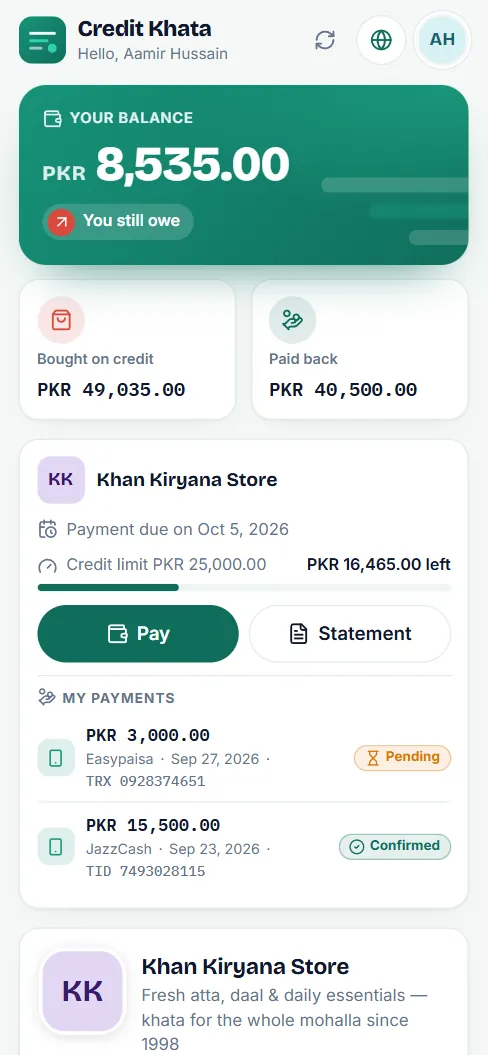
When customers can see their own entries and balance, they check them as they go, and the month-end surprise disappears. With a paper register, that means showing them the page. With a shared digital credit book, it means they open their account on their phone whenever they like, and they can confirm an entry or point at the one that looks wrong.
6. Record every payment straight away, even small ones
Part payments are normal: Rs 500 today, Rs 1,000 on Friday. Write each one the moment it is paid, and give a receipt if the customer wants one. A payment that is not written down is the fastest way to lose a customer's trust.
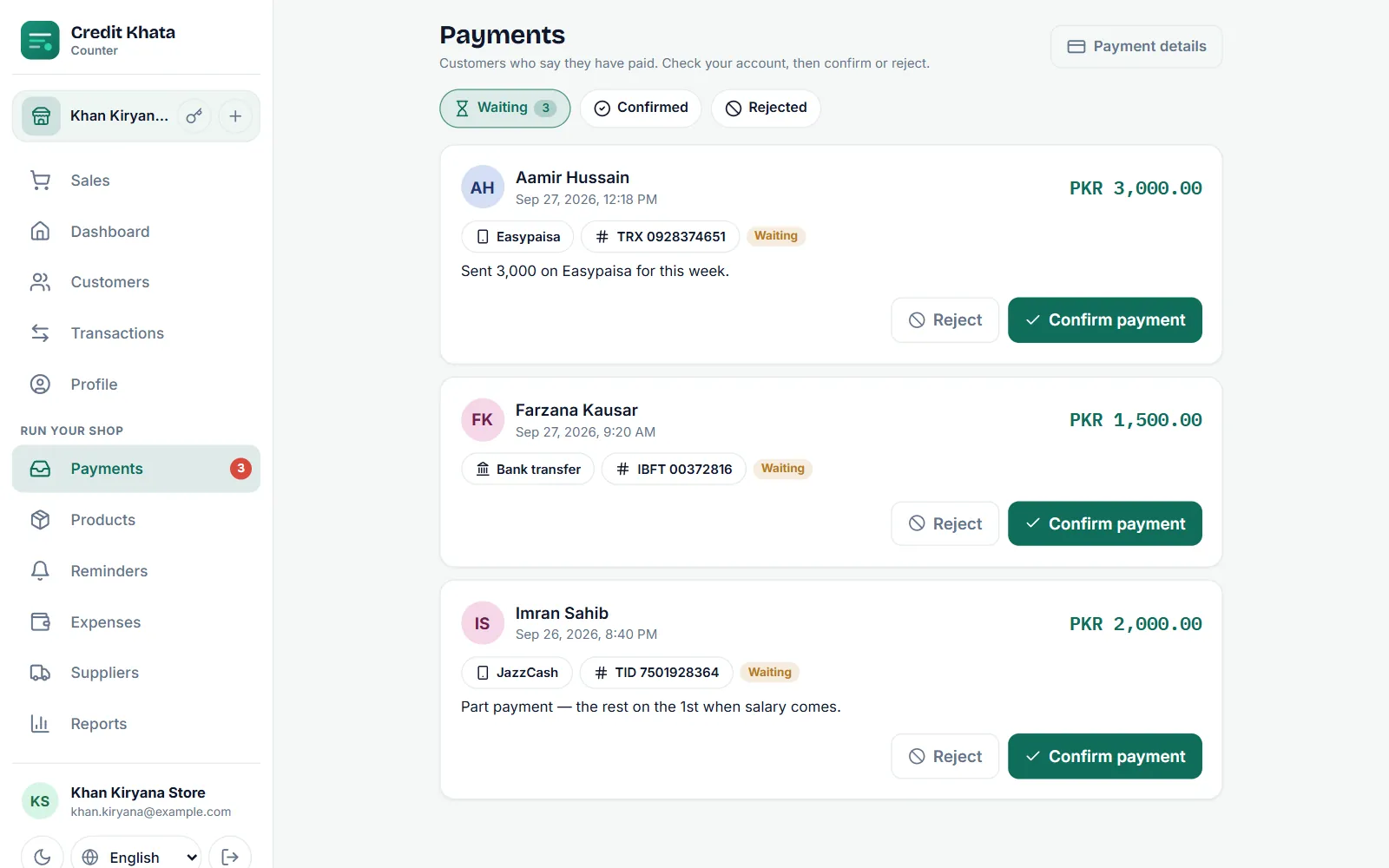
Make paying easy, too. Many customers would rather send money by JazzCash or Easypaisa than come to the counter, so put your wallet number where they can see it.
7. Keep cash sales and credit apart
Walk-in cash sales should not be written in anyone's account. Mixing them makes it hard to see what is actually owed. Record cash sales separately so the credit book shows only credit and payments.
8. Review old dues every week
Once a week, look at who owes you and for how long. Group it roughly:
| Age of the money owed | What to do |
|---|---|
| Up to 30 days | Normal. Remind on the due date. |
| 31–60 days | Remind again, with the statement. Hold new credit near the limit. |
| 61–90 days | Speak to the customer in person. Agree a payment plan. |
| Over 90 days | Stop new credit until a plan is agreed. |
The oldest money is the hardest to collect, so this list is where your attention pays off.
9. Remind politely and on time
Most customers who are late have simply not been asked. A short, friendly message with the exact amount and the due date works better than a hint at the counter in front of others. Never remind in public or in a group. Ready-made wording, in English and Roman Urdu, is in WhatsApp payment reminder templates for shops.
10. Set rules for staff
If a son, a brother or a salesman works the counter, decide who may give credit and who may change or delete an entry. The simplest rule: staff can sell on credit within a customer's limit, but only the owner can go past it or delete anything.
A simple weekly routine
| When | Task |
|---|---|
| Every sale | Write the entry with items, for the right customer |
| Every payment | Record it and give a receipt if asked |
| Every week | Check old dues, send reminders, adjust limits |
| Every month | Print or share statements for customers who ask, and review your total credit against your stock |
How Credit Khata fits this routine
Credit Khata is a shared credit ledger built around these habits:
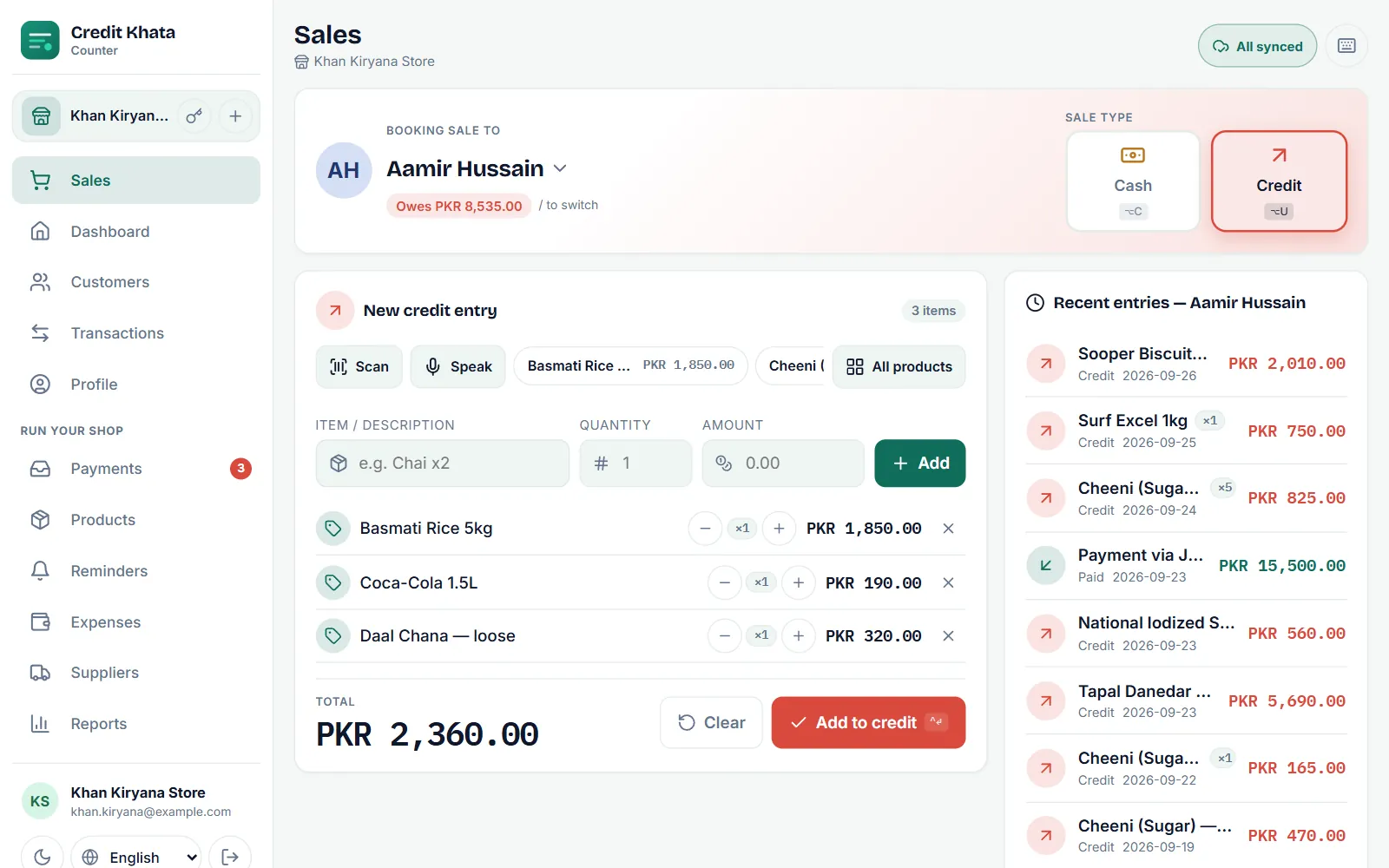
- Sales books each credit sale with its items and quantities, and warns before a sale passes the customer's limit. See Book a credit sale at the counter.
- Each customer can have a credit limit and a pay-by date, and customers past their date appear in an Overdue list.
- Reports → Old dues groups what you are owed into 0–30, 31–60, 61–90 and over 90 days: Reports: cash book, old dues, sales and profit.
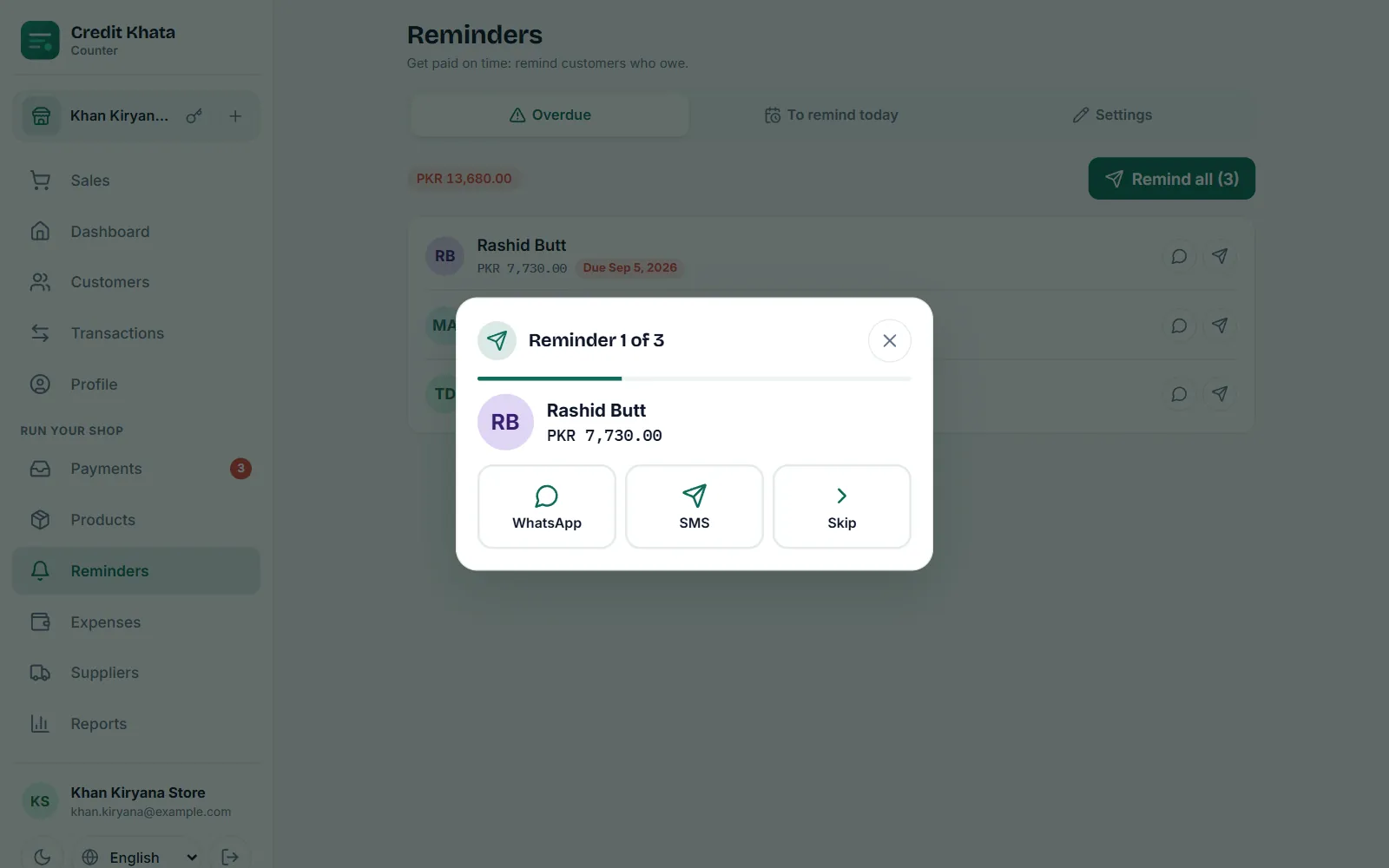
- Reminders open WhatsApp or SMS with the message already written.
- Customers see their own account from a link, and can pay you by wallet and tap I've paid.
- On Pro, staff get their own cashier or manager logins.
- It keeps working when the internet drops, and it is in Urdu and many other languages.
Every new shop gets a month of Pro to try everything, can stay on the Free plan after that, and customers never pay.
Mistakes to avoid
- Writing credit sales on loose slips "to copy in later".
- One limit for everybody, or no limit at all.
- Letting a total grow for months without a single reminder.
- Reminding a customer in front of other customers.
- Letting anyone at the counter delete entries.
Credit will always be part of running a kiryana store. With a limit, a date, a clear entry and a weekly look at old dues, it stays a service to your customers instead of a hole in your cash.
Frequently asked questions
Should a kiryana store give credit at all?
For most neighbourhood shops, credit is part of keeping regular customers. The aim is not to stop it but to control it with limits, due dates and a clear record.
How much credit should I give one customer?
A common rule of thumb is about one pay cycle of their normal purchases. Start new customers lower and raise the limit after they pay on time.
How often should I check who owes me money?
Once a week is a good rhythm: look at who has owed the longest and send reminders the same day.
How do I stop staff from giving too much credit?
Give staff their own logins with a cashier role and set a limit on each customer. A cashier cannot go past a limit; only the owner or a manager can. In Credit Khata, staff logins are part of Pro.
Was this post helpful?